
The Housing Bill Everyone Is Talking About: What the 21st Century ROAD to Housing Act Means for Texas Real Estate

Updated: Jul 14
Writer: Adriana Perez, Texas REALTOR®
Prefer to listen? Check out the podcast 🎧https://open.spotify.com/episode/5xusdSsU0nXcwD48OwahcU?si=MUDDdh_1TrCSeQ_R6rApTw
A major housing bill is moving forward, but what does it actually mean?
The real estate world has been watching a rare bipartisan housing bill make its way through Washington: the 21st Century ROAD to Housing Act.

The bill passed Congress with overwhelming support, 85–5 in the Senate and 358–32 in the House, and President Trump has said he will not sign it because of an unrelated dispute over voter ID legislation. However, according to AP reporting on July 10, 2026, he is expected to allow the bill to become law without his signature rather than veto it.
That unusual path has created a lot of confusion. So let’s slow it down.ll is not a mortgage-rate cut. It is not a new universal down payment assistance .
The bill is designed to increase the supply of housing, improve access to financing, reduce certain construction and inspection bottlenecks, support manufactured and modular housing, strengthen disaster recovery, and limit some purchases of single-family homes by very large institutional investors. The official enrolled bill describes its purpose as “to increase the supply of housing in America.”
For Texas, and especially for the Houston region, this matters.
Our housing conversations are no longer just about sales price. They are about monthly payment, insurance, taxes, flood risk, construction costs, rental demand, land use, infrastructure, investor activity, and whether families can actually find housing that fits their lives.
The Breakdown

The 21st Century ROAD to Housing Act is a federal housing package focused on long-term housing supply and access.
It may help over time by encouraging more housing production, improving certain financing tools, reducing duplicate inspection requirements for some voucher rentals, supporting manufactured and modular housing, and creating more structure around disaster recovery.
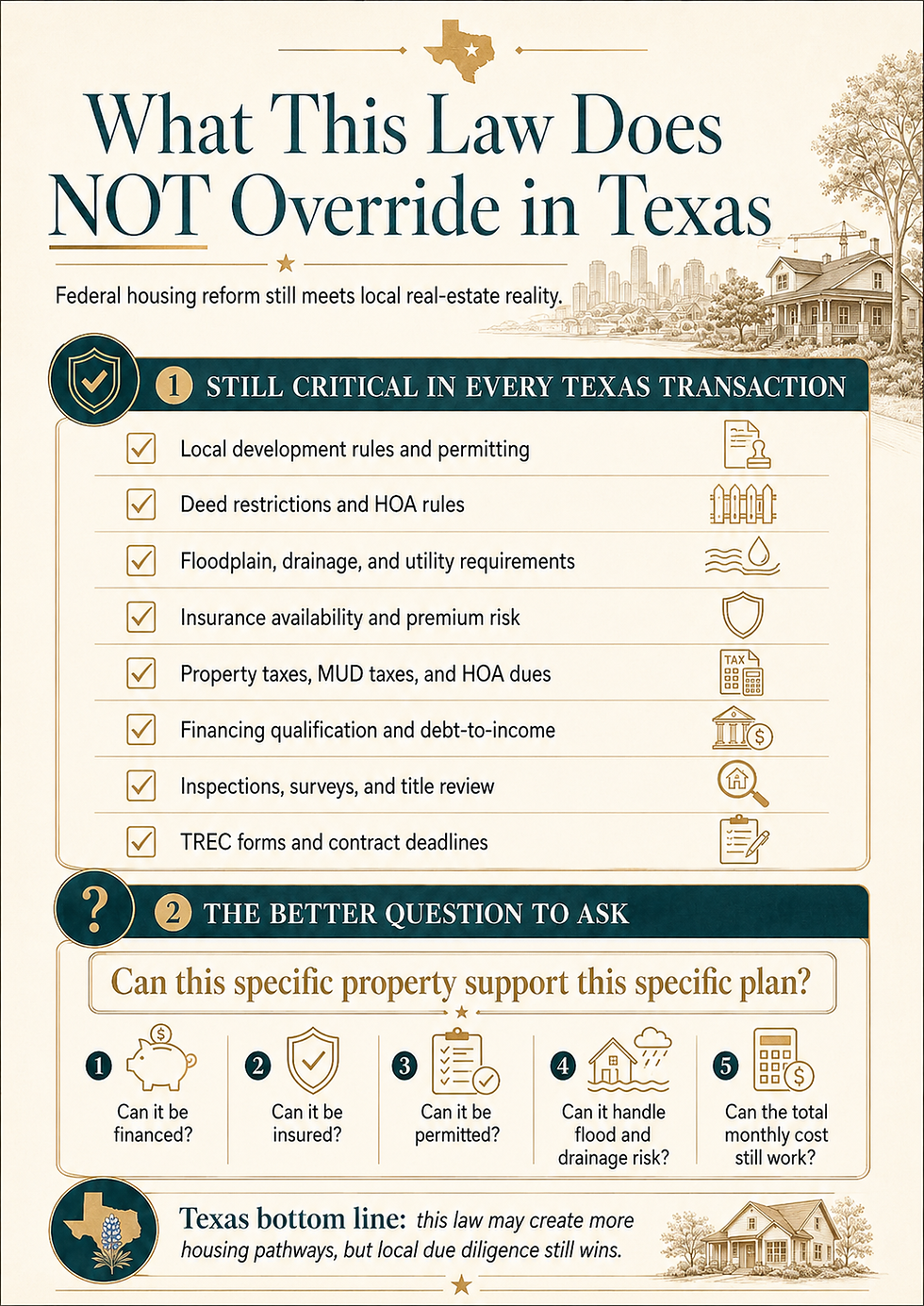
But it does not immediately:
lower mortgage rates;
reduce Texas property taxes;
erase homeowners insurance costs;
override deed restrictions or HOA rules;
make every ADU legal;
guarantee buyer assistance;
stop all investors from buying homes;
change TREC contracts;
or remove the need for careful local due diligence.
In plain English: this bill may help create more housing pathways over time, but buyers and renters still have to make decisions based on today’s real numbers.

Why this matters in Texas
Texas has long been viewed as a state where housing is more attainable than many coastal markets. But affordability has become more complicated.
In Greater Houston, HAR reported that 42% of area households could afford a median-priced home in Q1 2026, up from 37% the year before. The median home price was $331,500, and the typical monthly mortgage payment, including principal, taxes, and insurance, was about $2,400.
That sounds like improvement, and it is, but it still means more than half of Houston-area households could not afford the median-priced home under HAR’s affordability calculation.
The local rental picture is also strained. Rice University’s Kinder Institute reported that more than half of renters in Houston and Harris County are cost-burdened, meaning they spend more than 30% of income on rent. It also reported that roughly one-quarter of Houston and Harris County homeowners are cost-burdened.
So when we talk about housing affordability in Texas, we are not just talking about whether a house is listed at $300,000 or $400,000. We are talking about the full cost of living in the home.
That includes:
mortgage payment;
property taxes;
homeowners insurance;
flood insurance;
HOA dues;
utilities;
commute costs;
maintenance;
repairs;
and long-term risk.
That is why this bill matters, but also why it should not be oversold.

1. The bill encourages more housing supply

A major focus of the bill is encouraging local governments to remove barriers that slow down housing production.
The bill includes support for local housing-supply initiatives such as streamlining permitting, revising minimum lot-size requirements, adjusting parking requirements, encouraging duplexes, triplexes, fourplexes, multifamily housing, ADUs, and other forms of attainable housing.
For Texas, this could matter in fast-growing regions like Houston, Dallas-Fort Worth, Austin, San Antonio, Fort Bend County, Brazoria County, Montgomery County, and the Gulf Coast suburbs.
But here is the key: the federal bill does not automatically override local rules.
The bill specifically says it does not authorize HUD to mandate, supersede, or preempt local zoning or land-use policy.
That means local rules still matter.
In Houston, we often say the city has “no zoning,” but that does not mean “no rules.” The City of Houston states that its codes do not address land use, but development plans are still reviewed for Chapter 42, parking, trees and shrubs, setbacks, access, subdivision plats, building lines, and other development regulations.
So for buyers, sellers, builders, and investors, the question is not simply, “Does the federal bill allow this?”
The better question is:
Can this specific property support this specific plan under local rules, deed restrictions, utility access, floodplain requirements, permitting, financing, and insurance?
2. ADUs, duplexes, townhomes, and “missing middle” housing may get more attention

One of the more practical parts of the bill is the Accelerating Home Building Act section. It supports grants that can help local governments select pre-reviewed housing designs, also known as pattern books, for structures such as ADUs, duplexes, triplexes, fourplexes, cottage courts, courtyard buildings, townhouses, and other smaller-scale housing types.
This could become important in Texas because many families are looking for more flexible housing options.
Think about:
adult children living with parents longer;
aging parents moving closer to family;
homeowners wanting rental income;
small builders looking for repeatable plans;
investors exploring infill lots;
first-time buyers priced out of larger single-family homes;
and communities trying to add housing without only building large apartment complexes.
For Houston-area homeowners, this does not mean every backyard apartment or garage conversion is suddenly legal. You still need to check:
deed restrictions;
HOA rules;
setbacks;
lot size;
parking;
drainage;
utilities;
floodplain;
permitting;
fire/building code;
and lender or insurance limitations.
But it does signal that the federal government is paying more attention to smaller, flexible housing types that can help fill the gap between a traditional single-family home and a large apartment building.

3. Manufactured and modular housing may become more important
The bill includes a full title focused on manufactured housing. According to the Bipartisan Policy Center’s summary, the final bill addresses manufactured and modular housing by changing certain federal rules, reviewing modular housing financing barriers, increasing FHA manufactured-housing loan limits, and reauthorizing PRICE grants for manufactured-home communities.
For Texas, this is a big deal.
Manufactured and modular housing can matter in:
rural communities;
acreage purchases;
smaller towns;
workforce housing;
coastal recovery areas;
investor land strategies;
and areas where site-built homes have become too expensive.
But this is also an area where consumers need careful guidance.
A manufactured home may be affordable on paper, but the real question is whether the full deal works.
A buyer still needs to verify:
whether the land allows manufactured housing;
whether deed restrictions prohibit it;
whether utilities are available;
whether a septic system or well is needed;
whether the home qualifies for the buyer’s loan type;
whether insurance is available and affordable;
whether the home is in a flood zone;
whether the home is permanently affixed;
and how resale value may be affected.
This bill may make the category more viable over time, but it does not remove the need for property-level research.
4. Small-dollar mortgages could get more support
The bill allows HUD to create an FHA pilot program to expand access to small-dollar mortgages, defined in the bill as mortgages with an original principal balance of $100,000 or less secured by a 1- to 4-unit property used as the borrower’s principal residence.
The pilot may include lender incentives, adjusted FHA costs, grants for down payment and closing costs, appraisal costs, title insurance, outreach, and technical assistance.
This may not affect every Houston-area buyer because many homes are priced well above
$100,000. But it could matter for:
rural Texas buyers;
smaller towns;
manufactured homes;
older homes;
distressed properties;
lower-cost condos;
and communities where buyers struggle to find lenders willing to originate smaller loans.
The reason this matters is that smaller mortgages are often less profitable for lenders, even though buyers in lower-cost markets still need financing. If the pilot works, it could help create more practical financing options for lower-priced homes.
5. Voucher renters and landlords may see process improvements
This is one of the most practical pieces for renters and landlords.

The bill includes the Choice in Affordable Housing Act section, which allows some units to satisfy Housing Choice Voucher inspection requirements if they recently passed inspection through another qualifying housing program, such as Low-Income Housing Tax Credit housing, HOME-assisted housing, or USDA Rural Housing-assisted units.
Why does that matter? Because vouchers are often delayed or lost during the inspection process.
For voucher clients, timing is everything. A renter may find a home, submit paperwork, wait on approval, wait for inspection, wait for corrections, and then risk losing the unit to another applicant or missing voucher deadlines.
If implemented well by local housing authorities, this bill could reduce duplicate inspections for certain properties and make it easier for some landlords to participate.
That does not mean every voucher lease will suddenly move faster. Rent reasonableness, payment standards, bedroom size, landlord approval, local housing authority policies, and lease requirements still matter.
But for voucher clients and landlords, this is one of the bill’s most meaningful practical changes.
6. Disaster recovery is especially important for Texas
The bill includes the Reforming Disaster Recovery Act, which gives HUD responsibilities for long-term disaster recovery, resiliency, mitigation, housing needs, coordination with FEMA and SBA, and support for state and local governments.
The Texas General Land Office reports that HUD allocated more than $5.676 billion in Community Development Block Grant Disaster Recovery funds to Texas for long-term Hurricane Harvey recovery, administered by the GLO for housing, infrastructure, and planning.
Houston and the Gulf Coast understand something that many markets do not: housing affordability is also about resilience.
A home is not truly affordable if the buyer cannot insure it, repair it, elevate it, maintain it, or recover after a disaster.
For Texas buyers, this bill reinforces the importance of asking:
Is the property in a flood zone?
Has the area flooded before?
What does the elevation certificate show, if available?
What is the flood insurance quote?
What is the homeowners insurance quote?
What is the roof age?
Are there drainage concerns?
Is the home near bayous, reservoirs, industrial sites, or repeated street flooding?
What repairs would be needed after a major storm?
This is why a good Texas real estate conversation cannot stop at the listing photos.
7. Large institutional investors face new limits
One of the biggest headlines is the bill’s “Homes are for people, not corporations” section.
The bill generally defines a large institutional investor as a for-profit entity that invests in, owns, rents, manages, or holds single-family homes and has investment control of at least 350 single-family homes.
The bill says no large institutional investor may purchase, or enter into a contract to purchase, any single-family home, subject to exceptions.
This does not mean all investors are banned.
It does not appear to target the local investor buying one rental, a duplex, a small portfolio, or a flip. It is aimed at very large institutional ownership of single-family homes.
The bill also creates a renter outreach resource for tenants in properties owned by large institutional investors and requires them to report annually. Penalties for violations can be significant! Up to $1 million per violation or three times the purchase price of the property involved, whichever is greater.
The restrictions take effect 180 days after enactment and sunset 15 years after that effective date.
For Texas buyers, this may reduce some competition from very large single-family rental buyers over time. But it does not mean cash competition disappears. Buyers may still compete with small investors, individual cash buyers, builders, flippers, relocation buyers, and other owner-occupants.
For small investors, the message is simple: do not panic, but do pay attention. This bill is aimed at large institutional ownership, not ordinary local investors.
8. Veterans may get better visibility into VA loan options
The bill also includes housing provisions for veterans. It requires the Uniform Residential Loan Application to include a military service question and a disclosure stating that if the borrower answers yes, they may qualify for a VA Home Loan and should consult their lender about eligibility.

That sounds small, but it matters.
Some veterans and surviving spouses may not realize they could be eligible for VA financing. Others may compare FHA, conventional, and VA options without fully understanding the differences.
For Texas, this is important because we have a large veteran population, strong military presence, and many buyers who may qualify for VA benefits.
A buyer’s real estate team should ask early:
Have you ever served in the military, National Guard, reserves, or are you a surviving spouse of someone who served?
That one question can change the financing conversation.
It is also important to remember that VA loan eligibility is federal, while Texas disabled veteran property tax exemptions are separate and must be verified through the applicable appraisal district and taxing authorities.
9. Appraisals, housing counseling, and buyer protections also matter
The bill includes appraisal-related provisions and reforms to housing counseling and financial literacy programs. It also creates an opportunity for delinquent borrowers with certain federally backed loans to participate in available housing counseling.
For buyers, this matters because appraisals can affect financing, negotiations, cash-to-close, and whether a deal survives.
For homeowners, housing counseling can matter when someone is behind on payments and trying to avoid foreclosure.
For REALTORS®, lenders, and consumer educators, the broader message is this:
A successful housing market is not only about creating more units. It is also about helping people understand the transaction, compare financing options, avoid predatory situations, maintain homeownership, and recover when things go wrong.

What this means for different types of Texas consumers
For first-time buyers
This bill may eventually help through small-dollar mortgage support, more housing supply, better financing pathways, and possible appraisal-related improvements. But first-time buyers should not wait for a federal bill to “fix” the market. They still need to understand credit, income, debt-to-income ratio, cash-to-close, taxes, insurance, HOA dues, repairs, flood risk, and monthly payment.
The smartest move is still preparation.
For sellers
This bill does not automatically lower home values. It is more about long-term supply and access than immediate price reductions. Sellers should continue to price based on local comps, condition, buyer demand, days on market, incentives, repairs, and competition.
In some investor-heavy neighborhoods, large institutional investor restrictions could affect one category of buyer over time, but sellers may still see interest from owner-occupants, small investors, builders, and local cash buyers.
For renters
Renters may benefit indirectly if more housing is built over time. Voucher renters may benefit more directly if inspection processes become smoother for certain properties. But renters should still be prepared for application standards, income requirements, deposits, pet policies, background checks, and lease terms.
For voucher holders
This bill could help reduce delays in some voucher situations, especially where the unit has already passed certain qualifying inspections. Still, voucher clients should not assume every home will qualify. They need to confirm payment standard, bedroom size, rent reasonableness, landlord participation, inspection requirements, and local housing authority deadlines.
For landlords
The bill may make voucher participation more practical for some landlords by reducing duplicate inspection burdens in certain properties. Landlords should still understand fair housing obligations, inspection standards, lease requirements, rent reasonableness, payment timing, and local housing authority processes.
For veterans
The bill may help more veterans identify VA loan eligibility earlier in the mortgage application process. Veteran buyers should compare VA, FHA, conventional, and other loan options carefully. VA can be powerful, but property condition, appraisal requirements, funding fee status, disability exemption possibilities, and seller negotiations still matter.
For investors
Small investors should understand that this bill is not aimed at every person buying a rental property. It is aimed at large institutional investors controlling at least 350 single-family homes.
For local investors, the opportunity may shift toward thoughtful strategies: small multifamily, ADUs, infill lots, manufactured housing, modular housing, rural housing, repair programs, and affordable housing partnerships.
For builders and developers
Builders should pay attention to grants, pre-reviewed designs, housing-supply incentives, public land databases, infill development, and vacant commercial conversions. But in Texas, the hard questions remain local: utilities, drainage, detention, permitting, deed restrictions, site access, insurance, infrastructure, and construction costs.
For those who are relocating
Relocating to Texas still requires a full-picture analysis. A buyer moving from another state may see Texas home prices as attractive, but they need to understand property taxes, insurance, flood risk, utilities, commute patterns, MUD taxes, PID assessments, HOA rules, and long-term maintenance.
This bill may improve housing options over time, but relocation buyers still need guidance rooted in the local market.
What this bill does not solve
It is important to be honest.
This bill does not solve every housing issue.
AP notes that the bill does not address all causes of the housing affordability problem, including construction labor shortages, rising insurance costs, and wages that have not kept up with housing costs.
That is especially relevant in Texas.
Even if more housing is built, affordability can still be affected by:
mortgage rates;
insurance premiums;
property taxes;
flood risk;
construction labor;
material costs;
infrastructure limits;
local permitting;
utility availability;
appraisal gaps;
and household income.
The bill also includes a “No additional funds authorized” section, stating that no additional funds are authorized to be appropriated to carry out the Act or amendments made by it.
That means implementation matters. Agency guidance, appropriations, local participation, and program rollout will determine how much practical impact consumers actually feel.
What Texas consumers should watch next
The bill becoming law is only the beginning.
The real impact will depend on how HUD, FHA, USDA, VA, FHFA, CFPB, local housing authorities, cities, counties, lenders, and state agencies implement it.
Texas consumers, REALTORS®, builders, investors, and housing advocates should watch for:
HUD guidance on housing supply grants;
local applications for housing-production programs;
FHA small-dollar mortgage pilot details;
changes to manufactured and modular housing financing;
local housing authority updates on voucher inspections;
disaster recovery rulemaking and funding processes;
appraisal and reconsideration-of-value guidance;
VA loan disclosure updates;
institutional investor compliance rules;
and local public land databases.
The Lone Star Living takeaway
The 21st Century ROAD to Housing Act is one of the most significant federal housing bills in years, but it should be understood as a long-term housing-supply and housing-access bill not an overnight affordability fix.
For Texas, the biggest areas to watch are:
housing supply;
ADUs and missing-middle housing;
manufactured and modular homes;
small-dollar mortgages;
voucher inspection improvements;
disaster recovery;
veteran loan awareness;
and limits on very large institutional purchases of single-family homes.
For consumers, the lesson is clear:
Do not make a real estate decision based on headlines alone.
A good housing decision still requires looking at the full picture: price, payment, taxes, insurance, flood risk, property condition, financing, local rules, long-term costs, and your actual life needs.
We believe real estate education should help Texans make informed decisions. This bill may open new doors over time, but the smartest move is still the same: ask better questions, verify the details, and build your real estate plan around facts, not fear.


Comments