
A 2026 Homeowner’s Guide to Windstorm Coverage, Flood Insurance, TWIA, Policy Audits, Coverage Denials, Disaster Claims, and the Hidden Gaps That Can Cost Families Thousands

Updated: Aug 9
Prefer to listen? Check out the Podcast, but come back for the handouts!

Last researched and updated: July 15, 2026
Living along the Texas Gulf Coast comes with undeniable benefits: access to the water, strong communities, growing job centers, and neighborhoods that continue to attract homeowners and investors. However, it also brings an increasingly complicated insurance reality.
For many Gulf Coast residents, “home insurance” is not just one policy. It may be a combination of:
A homeowners or dwelling policy.
A separate windstorm and hail policy.
A separate flood policy.
Optional endorsements for water backup, code upgrades, temporary housing, equipment failure, or other uncovered risks.
This distinction matters because one hurricane can produce various types of damage. These include wind damage, rising water, wind-driven rain, roof failure, power loss, mold, temporary displacement, and contractor disputes. Each of these may be handled differently by different policies.
The good news is that homeowners are not powerless. While we cannot eliminate the Gulf Coast’s underlying catastrophe risk, we can reduce avoidable costs, preserve our home’s insurability, close dangerous coverage gaps, and prepare ourselves to manage complicated claims.
Why Texas Homeowners Are Feeling the Pressure
The Texas Department of Insurance reported a preliminary statewide average annual homeowners premium of $3,506 for 2025. TDI also reported more than 8.2 million active residential policies across homeowners, renters, condominium, and mobile-home categories, with nearly 160 companies participating in the broader Texas market. Average filed home-insurance rate requests were slightly negative during April through June 2026, but that does not mean every homeowner’s renewal will decrease—especially in coastal counties where wind coverage may need to be purchased separately.
For homeowners using the Texas Windstorm Insurance Association, the average residential TWIA premium was approximately $2,877 as of March 31, 2026. TWIA’s rates remained unchanged for 2026 policies. On June 30, 2026, TWIA’s Actuarial and Underwriting Committee recommended no rate increase for 2027. However, as of July 15, that recommendation was still scheduled for consideration by the full TWIA Board on August 4. It was not yet a final rate decision.
A coastal household could therefore pay for a regular home policy, a separate wind policy, and flood insurance—while still retaining large deductibles and exclusions.
The central question is no longer simply:
“How much is my insurance premium?”
The better question is:
“What would my policies actually pay if wind, flood, and rain damaged my home during the same storm?”
The Three-Policy Problem on the Texas Gulf Coast
1. Homeowners or Dwelling Insurance
A standard homeowners policy generally protects against covered risks such as fire, theft, vandalism, liability, and certain sudden water losses. Most home policies do not cover flooding, and policies written for homes along the Gulf Coast may exclude windstorm, hurricane, and hail damage. This means a policy carrying the words “homeowners insurance” may not insure the home against one of the most significant hazards in the region.
2. Windstorm and Hail Insurance
Some private insurers include wind and hail coverage. Others issue a companion homeowners policy that excludes those risks. When private-market wind coverage is unavailable, qualifying property owners in Texas’ designated catastrophe area may apply for TWIA coverage. This area includes all 14 first-tier coastal counties and portions of Harris County east of Highway 146. Eligibility generally requires a wind-coverage declination from at least one authorized insurer, appropriate windstorm certification, compliance with underwriting requirements, and an insurable property condition.
TWIA is not a complete homeowners policy. It is primarily windstorm and hail insurance.
3. Flood Insurance
Homeowners and TWIA policies generally do not insure damage caused by rising water. Flood coverage must ordinarily be purchased separately through the National Flood Insurance Program or a private flood insurer.
For a one-to-four-family home, the NFIP generally offers up to:
| Coverage Type | Maximum Generally Available |
|------------------------|-----------------------------|
| Residential Building | $250,000 |
| Personal Contents | $100,000 |
Building and contents coverage are purchased separately and carry separate deductibles. The NFIP also does not cover temporary housing or additional living expenses while the home is being repaired. This can become one of the largest uninsured costs following a major flood. As of July 15, 2026, the NFIP’s current federal authorization extends through September 30, 2026. Congress must act again to continue the program’s authority beyond that date.

Can Homeowners Actually Reduce Their Insurance Costs?
Yes, but the safest strategy is to reduce the property’s risk and correct the policy, not merely strip away coverage.

A lower premium is not a true savings if it comes from:
An unaffordable deductible.
A depreciated roof settlement.
Inadequate rebuilding limits.
No flood protection.
No temporary-housing protection.
Exclusions the homeowner did not understand.
A policy the mortgage company will not accept.
The goal should be the best combination of price, protection, financial strength, and claim usability.
Conduct an Annual Gulf Coast Home-Insurance Audit
Every homeowner should conduct this audit approximately 90 days before renewal. Waiting until the renewal bill arrives may leave too little time to correct property records, obtain inspections, complete repairs, or shop multiple insurers.
Step 1: Collect the Complete Policies
Create a digital folder containing:
Current homeowners declarations page.
Complete homeowners policy.
All endorsements and exclusions.
TWIA declarations and policy forms, if applicable.
Flood declarations and policy forms.
Renewal and nonrenewal notices.
Mortgage insurance requirements.
Most recent escrow analysis.
Roof invoices, permits, and warranties.
Windstorm certificates.
Elevation Certificate, if available.
Prior inspection reports.
Dated exterior and interior photographs.
Home inventory.
Prior claim correspondence.
The declarations page is only a summary. The endorsements and exclusions can materially change how the policy pays.
Step 2: Identify Which Policy Covers Each Risk
Complete a simple matrix:
| Potential Loss | Home Policy | TWIA/Private Wind | Flood Policy |
|-------------------------------|-------------|-------------------|--------------|
| Fire | Yes | No | No |
| Theft | Yes | No | No |
| Hurricane Wind | No | Yes | No |
| Flood | No | No | Yes |
| Wind-Driven Rain | Check Policy | Yes | No |
| Rising Water | No | No | Yes |
| Temporary Housing | Check Policy | Optional | No |
| Personal Liability | Yes | No | No |
TWIA offers optional coverage for certain indirect losses, including an Additional Living Expense endorsement and a Wind-Driven Rain endorsement. Additional Living Expense coverage is not automatically included and generally applies only to a primary residence made uninhabitable by a covered TWIA loss. Homeowners should look for endorsements such as TWIA-311 and TWIA-321 on their declarations page.

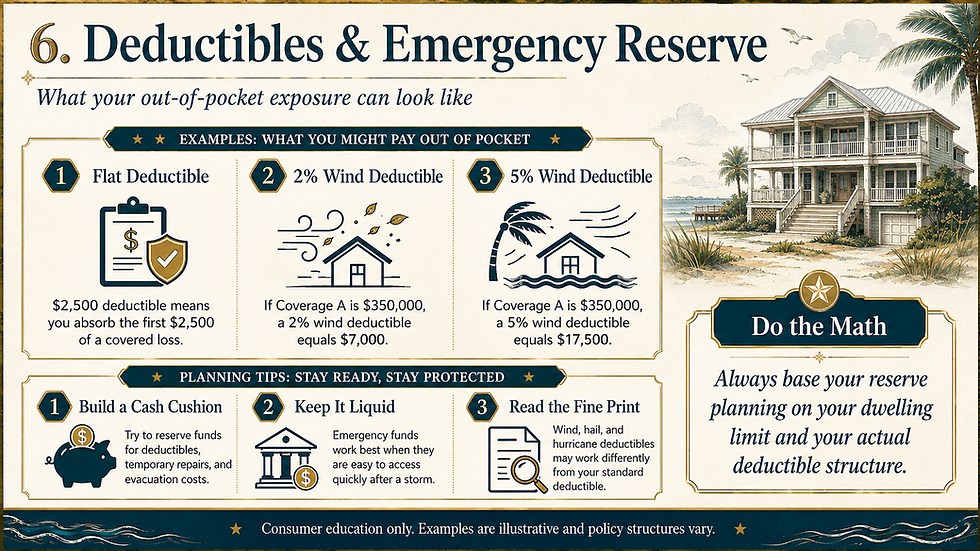
Step 3: Convert Every Percentage Deductible into Dollars
A deductible shown as “2%” is not 2% of the repair bill. It is generally calculated using the applicable insured limit.
For a home insured for $420,000:
| Deductible | Homeowner’s Potential Responsibility |
|------------|-------------------------------------|
| 1% | $4,200 |
| 2% | $8,400 |
| 3% | $12,600 |
| 5% | $21,000 |
A homeowner with separate wind and flood policies may owe more than one deductible after the same storm. NFIP building and contents coverage also have separate deductibles.
Before raising a deductible to reduce the premium, ask:
How much will the annual premium decrease?
How much additional loss am I accepting?
Do I have that amount available in cash?
Would the mortgage company permit the higher deductible?
Could I pay the wind and flood deductibles simultaneously?
Step 4: Verify the Cost to Rebuild
The dwelling limit should be based on reconstruction cost—not the property’s market value, tax appraisal, mortgage balance, or expected sales price.
Ask the insurer for its replacement-cost worksheet and verify:
Square footage.
Number of stories.
Exterior materials.
Roof type and slope.
Foundation.
Garage.
Interior finish level.
Number of bathrooms.
Attached structures.
Local labor and material assumptions.
Demolition and debris-removal costs.
Most companies require a home to be insured for at least 80% of replacement cost, while some require 100%. Insufficient coverage can leave the homeowner responsible for a significant rebuilding shortfall.
Also, ask whether the policy includes:
Extended replacement cost.
Guaranteed replacement cost, if available.
Ordinance-or-law coverage.
Inflation adjustments.
Debris removal above the dwelling limit.
Ordinance-or-law coverage matters because the repaired home may need to meet current codes even when the original home was built under older standards.

Step 5: Inspect the Roof Settlement Language
One of the most important questions is:
“Is my roof covered at replacement cost, actual cash value, or under a roof-payment schedule?”
Replacement-cost coverage generally pays the current cost of comparable repairs, subject to the deductible and policy terms. Actual-cash-value coverage subtracts depreciation for age and condition. Some insurers move older roofs from replacement cost to actual cash value at renewal.
Look for:
Actual Cash Value Roof Endorsement.
Roof Surfacing Payment Schedule.
Cosmetic Damage Exclusion.
Matching limitation.
Percentage-based roof settlement.
Age-based coverage restriction.
A lower premium may conceal a major reduction in what the insurer would pay for a roof claim.

Step 6: Verify Windstorm Certification
Coastal properties may need a WPI-8, WPI-8-E, or WPI-8-C Certificate of Compliance to qualify for TWIA coverage. The certificate demonstrates that applicable construction or repairs complied with required windstorm building standards.
Homeowners should verify certification before:
Replacing a roof.
Replacing siding.
Installing windows or exterior doors.
Replacing a garage door.
Building an addition.
Enclosing a patio.
Making structural repairs.
Inspections should be coordinated before the work is covered or concealed. TDI updated its coastal repair guidance in May 2026 and emphasizes that certain storm repairs must follow applicable windstorm inspection requirements.
A good contractor does not automatically guarantee a valid windstorm certificate. The inspection and documentation process must also be completed.
Step 7: Review the Flood Policy Beyond the Flood Zone
A flood-zone designation is not a guarantee that a property will—or will not—flood. FloodSmart states that nearly one-third of NFIP claims come from outside mapped high-risk areas.
Review:
Building limit.
Contents limit.
Building deductible.
Contents deductible.
Foundation type.
First-floor height.
Prior claims information.
Elevation Certificate.
Coverage for items below an elevated floor.
Whether the home’s replacement cost exceeds the NFIP limit.
Private flood alternatives.
Waiting period for a new or increased policy.
The NFIP limit can be significantly lower than the cost to reconstruct a modern Gulf Coast home. A homeowner with a $450,000 rebuilding exposure and only $250,000 in NFIP building coverage could face a serious limit gap after a total flood loss.

Step 8: Obtain Your CLUE Report
A Comprehensive Loss Underwriting Exchange report generally shows claims associated with the homeowner and property during the preceding seven years. Insurers can use that information when deciding whether to issue coverage and what to charge.
Review the report for:
Claims that do not belong to you.
Duplicate claims.
Incorrect claim amounts.
Claims assigned to the wrong property.
Claims still marked open after repairs.
Questions incorrectly recorded as claims.
Dispute inaccurate information with the reporting agency.
Insurance should be used for legitimate covered losses, but it should not be treated as a maintenance plan. Before filing a minor claim, understand the deductible, estimated covered payment, policy reporting requirements, and possible claims-history consequences.
Step 9: Review Insurance Credit Information
Private insurers may use an insurance credit score as one underwriting and pricing factor. It is not necessarily the same score shown by a consumer credit-monitoring application.
Under Texas Senate Bill 1644, insurers using credit information must periodically review and update an insured’s credit report at least every three years, reassess the policy rating, and adjust the premium based on the updated information. The requirement applies to policies issued or renewed after January 1, 2026.
Homeowners whose credit has improved should request updated quotes rather than assuming the current premium reflects the improvement.
TWIA does not use credit scoring to calculate its rates.
Step 10: Shop Comparable Coverage
Use the same limits and deductibles for every quote.
Compare:
Dwelling limit.
Extended replacement coverage.
Roof settlement.
Personal-property settlement.
Loss of use.
Liability.
Water damage.
Sewer backup.
Wind and hail.
Deductibles.
Ordinance and law.
Exclusions.
Insurer type.
Financial rating.
Complaint history.
HelpInsure, a service of TDI and the Office of Public Insurance Counsel, allows Texans to review sample rates, policy information, financial ratings, and complaint information for participating companies. Actual quotes still must be obtained from an agent or insurer.
An independent insurance agent may be able to compare multiple insurers, including companies not represented by a captive agent.
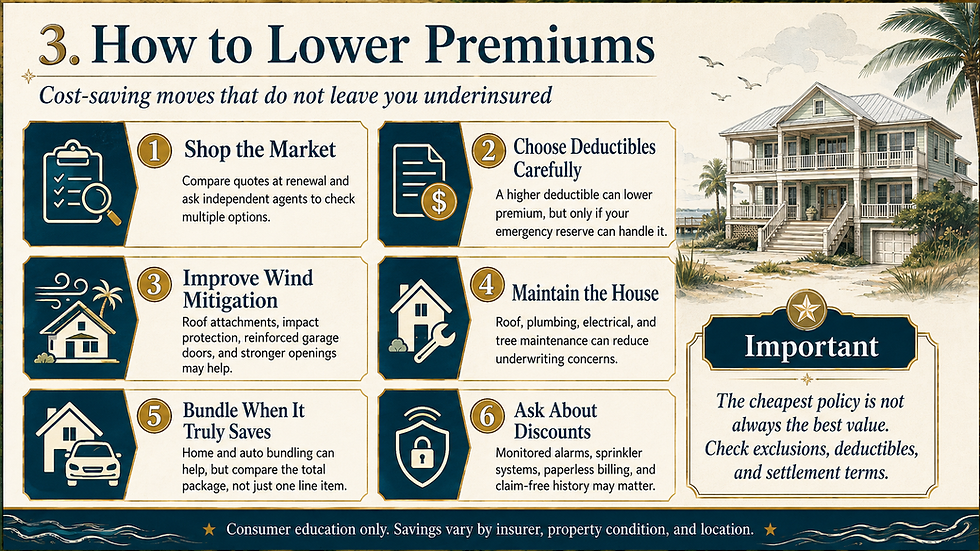
Improvements That May Reduce Premiums or Preserve Insurability
Maintain the Roof and Exterior
Insurers may inspect properties in person, through aerial imagery, or through third-party property data. TWIA can reevaluate a property to confirm that it remains in good repair and does not contain unrepaired damage or hazardous conditions.
Maintain:
Roof covering and flashing.
Gutters.
Siding.
Windows and exterior doors.
Garage doors.
Trees near the roof.
Plumbing.
Electrical systems.
HVAC equipment.
Water heaters.
Exterior steps and railings.
Detached structures.
Keep dated photographs and paid invoices after repairs.

Ask About Impact-Resistant Roofing
Qualifying impact-resistant roofing products are classified from Class 1 through Class 4, with Class 4 generally qualifying for the highest available impact-resistance credit. The actual discount is determined by the insurer.
Homeowners should obtain and retain the applicable Impact-Resistant Roofing Installation Form and product documentation.
Do not replace a functional roof solely for a small discount without comparing:
Upgrade cost.
Expected roof life.
Insurance savings.
Windstorm certification costs.
Warranty differences.
Deductible and settlement terms.
Ask About Opening Protection and Construction Credits
TWIA may offer credits for qualifying code-compliant construction and exterior-opening protection. Eligible improvements may include approved shutters, impact-resistant openings, and other windborne-debris protection installed and certified in accordance with applicable requirements. Ask the agent to identify the exact credit on the rating worksheet. Do not assume that having a WPI-8 automatically means every available discount has been applied.
Request All Available Private-Policy Discounts
Possible discounts vary by company and may include:
Newer-home discount.
Newer-roof discount.
Impact-resistant roofing.
Monitored fire or burglar alarm.
Automatic water-shutoff system.
Leak detection.
Fire sprinklers.
Claim-free history.
Multi-policy discount.
Paid-in-full discount.
Gated-community or protective-device credit.
Bundling can reduce the price, but Texas Senate Bill 213 prohibits an insurer from requiring a consumer to purchase both residential property and personal auto coverage from the same insurer or affiliate.

What If Insurance Companies Refuse to Cover the Home?
A denial does not always mean the property is permanently uninsurable. The correct response depends on why coverage was refused.
First: Obtain the Written Reason
Under House Bill 2067, insurers must provide a written explanation when they decline an application, cancel a policy, or refuse to renew it for decisions made after January 1, 2026.
Possible reasons include:
Roof condition.
Unrepaired damage.
Electrical or plumbing concerns.
Vacancy.
Business use.
Claims history.
Insurance credit.
Property condition.
Catastrophe exposure.
Inaccurate property information.
Ask what must be corrected and whether the company will reconsider after repairs or documentation.
Second: Correct Property-Data Errors
Insurance databases may contain incorrect information about:
Roof age.
Construction type.
Square footage.
Foundation.
Claim.
Occupancy status.
Distance from the coast.
Prior-loss status.
Provide permits, photographs, invoices, inspection reports, and certificates to correct the file.
Third: Consider the Voluntary Inspection Program
A Texas homeowner who has difficulty obtaining insurance because of the home’s condition can hire an approved Voluntary Inspection Program inspector and apply for a Certificate of Insurability. The certificate creates a presumption that the property’s condition is adequate for residential property insurance and is generally valid for three years. It does not guarantee coverage. An insurer may still refuse for another lawful underwriting reason or after reinspecting and identifying conditions in writing.
Fourth: TWIA for Coastal Wind and Hail
TWIA may provide windstorm and hail insurance for qualifying properties in the designated catastrophe area when private coverage is unavailable. It does not replace a complete homeowners policy.
Fifth: The Texas FAIR Plan
The Texas FAIR Plan provides limited residential property coverage when comparable coverage cannot be obtained in the regular market. New applicants generally need two qualifying declinations and must not have received a comparable offer. Two new declinations are generally required every two years for continued eligibility.
In a TWIA territory, a homeowner may need:
FAIR Plan or another companion policy for non-wind risks.
TWIA for wind and hail.
Separate flood insurance.
FAIR Plan coverage is limited and should not be assumed to be identical to a standard homeowners policy.
Sixth: Surplus-Lines Insurance
Surplus-lines insurers can sometimes cover properties standard insurers decline. These policies may contain higher deductibles, narrower coverage, more exclusions, roof depreciation, minimum-earned premiums, or binding arbitration provisions.
Unlike Texas-authorized insurers that participate in a guaranty association, surplus-lines insurers generally do not receive Texas guaranty-association protection if the company becomes insolvent.
Always verify:
Insurer financial strength.
Policy form.
Roof settlement.
Wind deductible.
Water limitations.
Cancellation provisions.
Mortgage-company acceptance.
Whether arbitration is required.
The Danger of Force-Placed Insurance
A homeowner with a mortgage ordinarily cannot simply allow coverage to lapse. If required insurance disappears, the mortgage servicer may obtain force-placed coverage and charge the borrower.
Force-placed insurance is usually designed primarily to protect the lender’s collateral. It may cost substantially more and may not provide the homeowner with adequate contents, liability, or loss-of-use protection.

A Realistic Worst-Case Gulf Coast Scenario
The following example is fictional. It is designed to show how multiple policies, deductibles, limits, and claim disputes can interact.
Before the Storm
A Brazoria County homeowner has:
| Item | Hypothetical Amount |
|--------------------------------|---------------------|
| Cost to Rebuild Home | $420,000 |
| Mortgage Balance | $315,000 |
| Companion Homeowners Coverage | $420,000, excluding wind and flood |
| TWIA Wind Coverage | $420,000 |
| TWIA Deductible | 2%, or $8,400 |
| NFIP Building Coverage | $250,000 |
| NFIP Contents Coverage | $100,000 |
| Flood Building Deductible | $2,000 |
| Flood Contents Deductible | $2,000 |
| Emergency Savings | $12,000 |
The homeowner purchased TWIA Additional Living Expense coverage but has no private flood policy providing temporary-housing protection.
The Hurricane
A major hurricane strikes the Gulf Coast. Before the floodwater arrives:
The roof is partially removed by wind.
The garage door fails.
Wind-driven rain enters the attic.
A tree damages the structure.
Upper-level ceilings and insulation become wet.
Several hours later, 18 inches of floodwater enters the first floor.
Estimated loss:
| Category | Estimated Damage |
|--------------------------------|--------------------|
| Wind-Related Building Damage | $140,000 |
| Flood-Related Building Damage | $280,000 |
| Personal Property Replacement | $90,000 |
| Temporary Housing and Additional Expenses | $45,000 |
| Other Uncovered or Limited Expenses | $25,000 |
| Total Household Loss | $580,000 |
The Wind-Versus-Flood Dispute
TWIA’s first estimate accepts only $75,000 of wind damage. The flood insurer accepts $230,000 of building damage and values damaged personal property at $55,000 after depreciation.
Initial payments:
| Source | Initial Calculation | Payment |
|--------------------------------|---------------------|------------------|
| TWIA | $75,000 − $8,400 | $66,600 |
| NFIP Building | $230,000 − $2,000 | $228,000 |
| NFIP Contents | $55,000 − $2,000 | $53,000 |
| Initial Insurance Recovery | | $347,600 |
The household has suffered an estimated $580,000 economic loss but initially receives $347,600.
Initial gap: $232,400
The problem is not only the amount. The wind carrier says flood caused part of the damage, while the flood carrier says some water entered because the roof and exterior openings failed first. The homeowners policy excludes both causes.
How the Homeowner Works Through the Claim
The homeowner:
Documents every room, waterline, opening, roof section, appliance, and damaged possession before disposal.
Reports claims to every potentially applicable insurer.
Makes only emergency temporary repairs before inspections.
Saves every receipt.
Contacts the mortgage servicer’s disaster department.
Obtains the insurers’ complete estimates.
Hires an independent engineer experienced in hurricane causation.
Separates wind, wind-driven rain, flood, and preexisting damage.
Obtains itemized contractor estimates.
10. Submits written supplemental claims.
After reviewing additional photographs, roof measurements, contractor estimates, and the engineer’s report:
TWIA increases accepted wind damage to $130,000.
The NFIP building claim reaches its $250,000 policy limit.
The contents payment remains $53,000 after valuation and deductible.
Much of the temporary-housing expense remains disputed or uncovered.
Because NFIP deductibles are applied to the loss rather than subtracted from the policy limit, a sufficiently large covered loss may still produce payment of the full available limit.
Final hypothetical recovery:
| Source | Final Payment |
|--------------------------------|---------------------|
| TWIA | $130,000 − $8,400 |
| NFIP Building | $250,000 |
| NFIP Contents | $53,000 |
| Total Insurance Recovery | $424,600 |
Remaining household exposure:
| Remaining Gap | Amount |
|--------------------------------|---------------------|
| Building Damage, Allocation, and Deductible Gap | $48,400 |
| Contents Depreciation and Deductible Gap | $37,000 |
| Temporary Housing | $45,000 |
| Other Uncovered Expenses | $25,000 |
| Total Remaining Gap | $155,400 |
The homeowner had insurance. The homeowner still lost more than $155,000. That is why policy limits, endorsements, deductibles, flood coverage, and temporary-housing protection matter before the storm.

What to Do After a Major Storm
First 24 Hours
Protect people first. Do not enter an unsafe structure. When access is permitted:
Photograph before moving or discarding items.
Record video of every room.
Photograph waterlines.
Photograph upper-level water damage separately.
Preserve security-camera or doorbell footage.
Make temporary repairs to prevent additional damage.
Save receipts.
Do not begin unnecessary permanent reconstruction before inspection.
File Every Potentially Relevant Claim
Report the facts without making unsupported conclusions about causation.
Better:
“The roof covering was missing, water entered the attic and upper rooms, and floodwater later entered the first floor.”
Less helpful:
“Flood caused everything.”
The first statement preserves the distinction between wind, wind-driven rain, and rising water.
Contact the Mortgage Servicer
Insurance payments may be issued jointly to the homeowner and mortgage company. Servicers commonly release funds in stages as repairs progress.
Texas’ Consumer Bill of Rights states that when a lender receives a claim payment, it generally must notify the borrower within 10 days and explain the requirements for releasing the money. After the borrower satisfies those requirements, the lender generally must release the funds or explain what remains necessary.
Do not stop mortgage payments without a written forbearance or hardship agreement. Forbearance temporarily reduces or pauses payments; it does not erase the debt.
Create a Claim Log
Record:
Claim numbers.
Adjuster names.
Inspection dates.
Documents submitted.
Estimates received.
Payments.
Deductibles.
Deadlines.
Telephone conversations.
Written decisions.
Disputed items.
Follow telephone calls with a confirmation email.
Compare Estimates Line by Line
Do not compare only the grand totals. Review:
Measurements.
Quantities.
Labor rates.
Material prices.
Demolition.
Drying.
Insulation.
Cabinets.
Flooring.
Electrical.
HVAC.
Permits.
Code upgrades.
Debris removal.
Contractor overhead and profit.
Depreciation.
Taxes.
Missing items.
Submit a written supplemental request with supporting documentation.

Important Claim Deadlines
Texas Home-Insurance Claims
Texas insurers generally have 15 business days to acknowledge a first-party claim. After receiving the information reasonably needed to make a decision, the company generally has 15 business days to accept or reject the claim. It may extend the decision period by 45 days if it explains why additional time is needed. Once payment is approved, it is generally due within five business days. Catastrophe-related extensions may apply.
TWIA
A TWIA claim generally must be filed within one year of the loss. When TWIA accepts coverage but the homeowner disputes the amount, the homeowner generally has 60 days from TWIA’s acceptance notice to demand appraisal, subject to possible catastrophe-related extensions. Missing that deadline can affect the right to challenge TWIA’s amount-of-loss determination.
NFIP
The NFIP generally requires a signed Proof of Loss within 60 days of the loss unless FEMA formally extends the deadline for the disaster. The adjuster may assist, but the policyholder remains responsible for timely submission. If a flood claim is denied or underpaid, the policyholder generally has 60 calendar days from the denial letter to appeal to FEMA. A lawsuit generally must be filed within one year of the denial, and filing an administrative appeal does not extend the one-year lawsuit deadline. Completing appraisal can eliminate the option to file a FEMA appeal, so homeowners should understand the consequences before selecting a dispute process.

Appraisal, Complaints, Public Adjusters, and Attorneys
Appraisal
Appraisal is generally designed to resolve a dispute over the amount of a covered loss. It does not necessarily resolve a dispute over:
Whether the policy covers the damage.
Whether wind or flood caused it.
Whether an exclusion applies.
Whether the policy was valid.
Whether the insurer acted unlawfully.
Texas Senate Bill 458 requires personal auto and residential property policies issued or renewed after January 1, 2026, to include an appraisal provision for amount-of-loss disputes. Policy language and applicable rules should still be reviewed carefully.
TDI Complaints
TDI can review complaints involving insurers, agents, and adjusters and determine whether the company followed Texas law and the policy. It cannot always decide disputed facts, set repair prices, or force payment when the dispute depends on causation or valuation rather than a legal or policy violation.
Public Insurance Adjusters
A licensed public adjuster may assist a homeowner with claim preparation and negotiation, but fees can be significant. TDI states that public adjusters may charge up to 10% of the total amount paid on the claim, depending on the contract. A contractor performing the repairs cannot also act as the homeowner’s public adjuster on the same claim.
Attorneys
Legal advice should be considered when:
Coverage is denied.
Wind and flood insurers blame each other.
A deadline is approaching.
The loss is substantial.
The insurer alleges misrepresentation.
Appraisal will not resolve the core dispute.
The homeowner is asked to sign a full release.
A lawsuit may be required.

Texas Contractor Rules Homeowners Must Know
It is illegal in Texas for a contractor or roofer to waive, rebate, or absorb a property-insurance deductible. An insurer may require proof that the homeowner paid it.
Avoid contractors who:
Promise to “cover” the deductible.
Ask you to sign a blank contract.
Demand full payment upfront.
Claim they will negotiate coverage with the insurer.
Promise to recover every dollar.
Pressure you to assign insurance rights.
Refuse to provide references or insurance documentation.
Get multiple written bids and retain proof of every payment.
What Communities Can Do When Insurance Becomes Difficult to Obtain
Insurance affordability cannot be solved entirely one house at a time. Community-wide loss reduction can improve safety, protect property values, and strengthen long-term insurability.
Local governments can:
Adopt and enforce modern wind-resistant construction standards.
Preserve windstorm certificates, permits, and elevation records.
Improve drainage and regional detention.
Protect natural flood-storage areas.
Restrict unsafe development in high-risk floodways.
Require appropriate elevation for new construction.
Seek grants for elevation, acquisition, and repetitive-loss mitigation.
Join or improve participation in FEMA’s Community Rating System.
Provide residents with transparent flood and insurance information.
FEMA’s Community Rating System rewards communities that exceed minimum NFIP floodplain-management requirements through flood-insurance discounts for qualifying policyholders. Discounts can reach as high as 45% in the strongest participating communities.
The Texas Water Development Board administers Flood Mitigation Assistance and Flood Infrastructure Fund programs that can help communities finance drainage, acquisition, elevation, and other mitigation projects.
For repeatedly flooded neighborhoods, government-funded voluntary buyout programs may purchase eligible properties, demolish the structures, and preserve the land as open space or flood storage. These programs are generally administered through local governments and depend on available funding and program eligibility.
The answer to an increasingly uninsurable neighborhood is not simply to force insurers to ignore risk. It is to reduce the frequency and severity of losses—and document those improvements in a way insurers, lenders, regulators, and public programs can recognize.

Your Gulf Coast Homeowner Action Plan
This Weekend
Find every declarations page.
Confirm whether wind and hail are included.
Confirm whether you have flood insurance.
Convert percentage deductibles into dollars.
Photograph every room.
Photograph the exterior and roof.
Store documents in the cloud.
This Month
Verify your WPI certificate.
Request your CLUE report.
Request the insurer’s rebuild-cost estimate.
Review roof settlement terms.
Ask for every available discount.
Obtain comparable quotes.
Compare NFIP and private flood options.
Confirm temporary-housing coverage.
Create a dedicated deductible reserve.
Before Renewal
Begin shopping 75 to 90 days in advance.
Correct inaccurate property information.
Repair underwriting concerns.
Confirm insurer licensing and financial strength.
Review all endorsements and exclusions.
Never cancel existing coverage until the replacement policy is formally bound.
Before Hurricane Season
Confirm policy effective dates.
Update the home inventory.
Save emergency contacts.
Understand mortgage loss-draft procedures.
Know where you will stay.
Keep deductibles accessible.
Do not wait for a storm to enter the Gulf before buying coverage.
Texas Gulf Coast homeowners cannot control hurricane paths, regional flood risk, construction inflation, reinsurance costs, or every underwriting decision. However, we can control whether we understand our policies.
A well-prepared homeowner knows:
Which policy covers each risk.
How much each deductible costs in dollars.
Whether the roof is depreciated.
Whether flood limits are sufficient.
Whether temporary housing is covered.
Whether windstorm certificates are complete.
Whether property records are accurate.
What to do if coverage is refused.
What deadlines apply after a loss.
How to document and challenge an underpaid claim.
The most dangerous insurance policy is not always the most expensive one. It is the policy that appears affordable—until the homeowner discovers what it does not cover.
Consumer and Professional Disclaimer
This article is provided for general educational and real-estate information. It is not legal, insurance, engineering, tax, lending, construction, or financial advice. Insurance eligibility, premiums, policy language, deductibles, exclusions, claim procedures, and available endorsements vary by insurer, property, location, and policy period. Laws, regulations, rates, federal program authorizations, and insurer underwriting requirements may change.
Homeowners should review their complete policy contracts and consult a licensed Texas insurance agent, qualified attorney, engineer, mortgage servicer, floodplain administrator, or other appropriate professional regarding their specific property and circumstances. References to TWIA, FEMA, NFIP, TDI, the Texas FAIR Plan, or other public programs are educational and do not constitute an endorsement or guarantee of eligibility, coverage, premium savings, claim payment, or program assistance.
Adriana Perez is a Texas REALTOR® and is not acting as an insurance agent, insurance adjuster, attorney, engineer, or floodplain professional through this article.


Comments