
TSAHC Raises Income Limits and Introduces a New 5% Repayable Down Payment Assistance Option

Last updated: August 5, 2026
Written By: Adriana Perez
For many Texas homebuyers, qualifying for a mortgage is not the biggest obstacle. Coming up with the down payment, closing costs and prepaid expenses is often the harder part.
Recent changes from the Texas State Affordable Housing Corporation, commonly known as TSAHC, could make homeownership assistance available to more Texas households. TSAHC has significantly increased the income limits for its two primary homebuyer programs and announced a new option providing assistance equal to 5% of the mortgage loan amount.
The new 5% assistance is a repayable second lien. It is not a grant, and it is not automatically forgiven.
What changed with TSAHC’s income limits?
TSAHC increased the maximum income limit for its Home Sweet Texas Home Loan Program to 150% of area median family income, or AMFI. The maximum for the Homes for Texas Heroes Program increased to 170% of AMFI.

TSAHC’s published Houston examples are $156,000 for Home Sweet Texas and $176,800 for Homes for Texas Heroes. Home Sweet Texas is available to qualifying Texas buyers regardless of profession. Homes for Texas Heroes serves qualifying educators, police and public security officers, firefighters, EMS personnel, corrections officers, veterans, active-duty military members and certain nursing or allied-health faculty.
The Home Sweet Texas limits became effective June 13, 2026. The higher Homes for Texas Heroes limits became effective July 9, 2026.

Your county matters
The figures above should not be treated as one universal Houston-area limit. TSAHC determines the applicable limit based on the county in which the home is located.

Some counties within the Greater Houston market have different limits. For example, the official 2026 table lists Fort Bend County at $156,000 for Home Sweet Texas and $176,800 for Homes for Texas Heroes, while Brazoria County is listed at $189,000 and $214,200, respectively. A buyer should therefore have the lender check the exact county limit instead of relying on a general Houston income limit.

What is the new 5% TSAHC assistance product?
TSAHC announced a new down payment assistance option equal to 5% of the borrower’s mortgage loan amount. The product is structured as a 30-year deferred repayable second lien.

Second lien: A separate lien is recorded behind the primary mortgage. Deferred: The buyer does not make regular monthly payments on the assistance. Repayable: The balance remains a debt and is not automatically forgiven. Thirty-year term: The obligation can remain attached to the property for an extended period unless it is repaid sooner.
According to TSAHC’s announcement, repayment can be triggered when the buyer sells or transfers the property, refinances or pays off the first mortgage, or stops occupying the property as the principal residence. The assistance may reduce the buyer’s immediate cash requirement, but it can also affect the buyer’s proceeds when selling and the cost of refinancing later.

A simple example
Suppose a buyer receives a first mortgage of $350,000. Five percent of that loan amount would be $17,500.
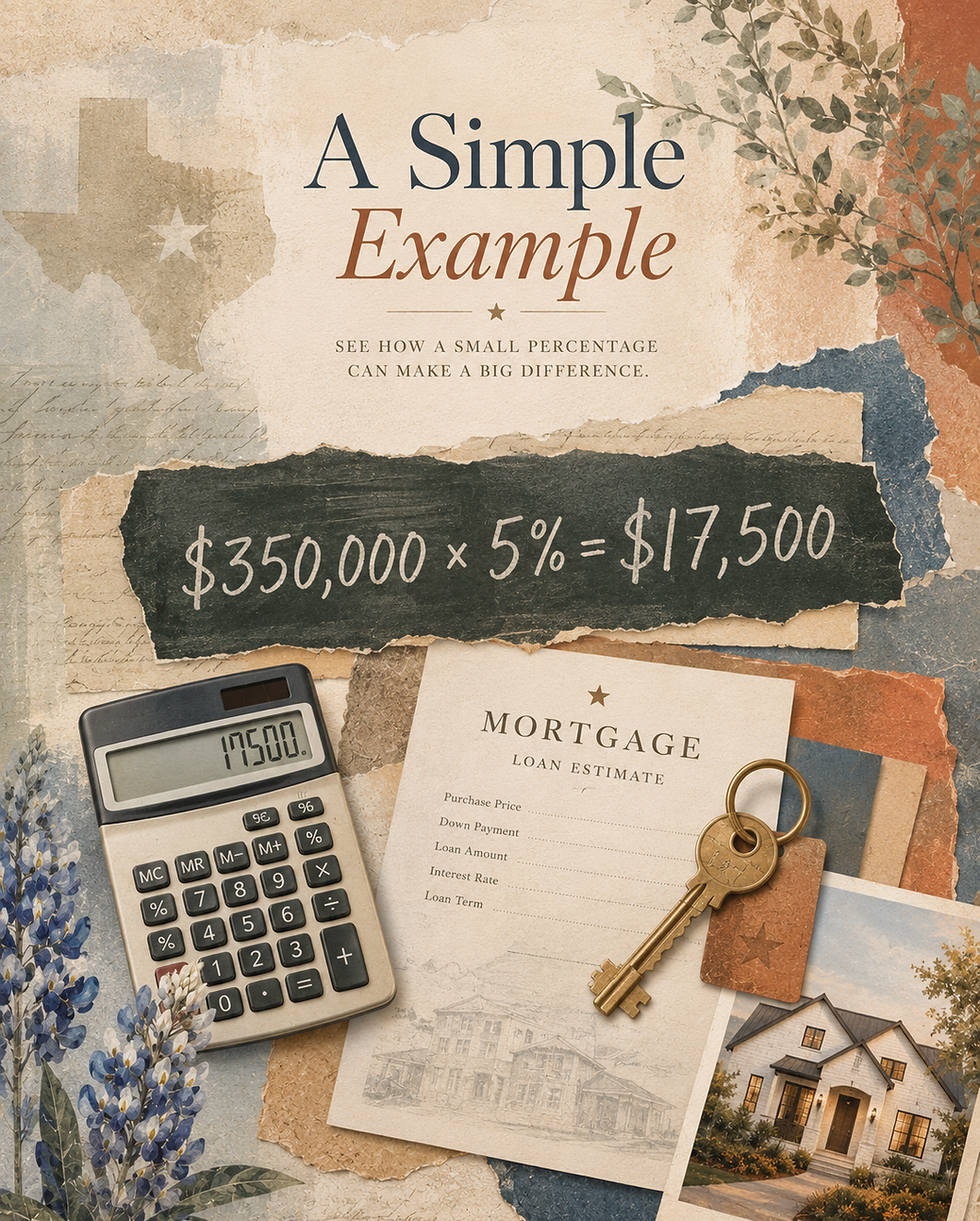

That $17,500 could substantially reduce the amount the buyer needs for the down payment and eligible closing expenses. However, the $17,500 does not disappear after closing. It remains secured by the second lien and must eventually be repaid under the product’s terms.
TSAHC guidelines generally allow DPA funds to be applied toward the required down payment, closing costs, prepaid expenses and eligible mortgage-related fees. The money generally cannot be used to pay unrelated consumer debt or simply be distributed to the borrower as cash.
Repayable assistance is not the same as forgivable assistance
The terminology surrounding DPA can be confusing. These products should not be described interchangeably.

A grant generally does not create a second lien and repayment is generally not required after applicable conditions are met. TSAHC’s three-year deferred forgivable second lien is forgiven after three years, subject to its conditions. The new 30-year deferred repayable second lien is different because there is no automatic forgiveness.
TSAHC’s existing three-year product is forgiven in full after the third anniversary of closing. It is not forgiven gradually. If a repayment event occurs during the three-year period, the entire balance may be due. The new 30-year option is different because the balance remains repayable. A buyer should never be told that this product is free money.
Who may qualify for the new product?
The higher income limits make more households eligible to be considered, but meeting an income limit does not guarantee loan approval. TSAHC’s public rate table places the new 5% product in its Bond FHA, VA and USDA category and lists a minimum FICO score of 620. Additional mortgage-agency requirements, debt-to-income standards and lender overlays may apply.

First-time-homebuyer requirement
Under TSAHC’s current Bond DPA guidelines, applicants generally cannot have held an ownership interest in a principal residence during the previous three years. Exceptions may apply when the property is in a qualifying targeted area or when the applicant meets TSAHC’s definition of a qualified veteran.
Broader income calculation
Bond DPA income testing may include more income than the lender uses to approve the first mortgage. TSAHC’s current guidelines require lenders to consider income from family members who will live in the home and hold an ownership interest. This can include the income of a non-purchasing spouse. All income sources must be disclosed and evaluated for program compliance.
Purchase-price limits
Bond DPA is also subject to TSAHC purchase-price limits. A buyer may fall below the income limit and still be ineligible if the property exceeds the applicable maximum purchase price.
Principal-residence requirement
TSAHC assistance is intended for a buyer’s primary residence. It cannot ordinarily be used to purchase an investment property, vacation home or second home.
Homebuyer education
At least one borrower must complete a TSAHC-approved homebuyer education course before closing.
Approved lender requirement
Buyers do not apply directly to TSAHC. They must work with a participating TSAHC-approved mortgage lender, who will review eligibility, reserve the assistance and complete the required program documentation.

Can the new 5% product be combined with a Mortgage Credit Certificate?
Buyers should not assume that it can. TSAHC’s current program guidelines state that Mortgage Credit Certificates may be issued with Non-Bond DPA but not with Bond DPA. Because the public TSAHC table identifies the new 5% repayable option as a Bond product, the approved lender should verify whether an MCC can be used in the proposed transaction.
An MCC and DPA provide different benefits. DPA addresses upfront cash needs, while an MCC may provide a federal income-tax credit related to mortgage interest. Buyers should consult an appropriate tax professional regarding the personal tax impact of an MCC.
Why buyers must compare more than the assistance amount
A larger DPA amount is not automatically the least expensive choice. TSAHC publishes different first-mortgage rates for different loan and assistance combinations. Mortgage loans with DPA may carry a different interest rate than loans without assistance. A higher rate can increase the monthly payment and the total interest paid over the life of the first mortgage.

A complete comparison should include the first-mortgage interest rate and APR; monthly principal-and-interest payment; mortgage insurance or funding fees; total cash required at closing; the amount and terms of the second lien; TSAHC and lender fees; expected length of ownership; the possibility of refinancing; and the amount that would be owed when the property is sold.
The best choice is not always the option offering the largest amount of assistance. It is the option that creates a sustainable payment and fits the buyer’s expected plans for the property.
Questions to ask a TSAHC-approved lender

1. Is the 5% product currently open for reservations, and are funds available? 2. Is the loan being processed through Home Sweet Texas or Homes for Texas Heroes? 3. What is the exact income limit for the property’s county? 4. Whose income must be counted for this Bond DPA transaction? 5. Does the buyer satisfy the first-time-homebuyer requirement or an applicable exception? 6. What purchase-price limit applies? 7. What FICO score, debt-to-income ratio and underwriting requirements apply? 8. What are the first-mortgage rate, APR, payment and lender fees? 9. What amount will be secured by the second lien? 10. Exactly which events require repayment? 11. Can the second lien be subordinated during a refinance, or must it be paid off? 12. Can the product be combined with an MCC or another assistance source?
Rates and funding availability can change. A rate should not be advertised or promised until the approved lender confirms it for the specific buyer and transaction.
What this means for Houston-area homebuyers
The higher limits may help households that previously earned too much for TSAHC assistance but still struggle to save enough for the down payment and closing costs. The new 5% repayable option may also help a qualified buyer preserve savings for moving expenses, repairs and emergency reserves. But its long-term repayment obligation makes buyer education essential.
Qualified buyers may be able to receive assistance equal to 5% of the mortgage loan amount through a deferred, repayable second lien with no regular monthly payments. Eligibility, rates, county limits, funding availability and repayment terms must be confirmed by a TSAHC-approved lender.
It should not be advertised as a 5% grant, free money or guaranteed assistance.

Ready to explore your Texas homebuying options?
A successful DPA transaction requires coordination between the buyer, REALTOR® and approved lender. The lender determines financing and program eligibility, while the REALTOR® helps the buyer evaluate properties, contract terms, seller contributions and the overall cost of ownership.
Contact Adriana Perez with The Trochilidae Group to begin planning your Houston-area home search and receive an introduction to a TSAHC-approved lender who can evaluate the current programs.
Important notice
This article is for general educational purposes and is not a commitment to lend, a guarantee of program eligibility, or tax, legal or financial advice. TSAHC guidelines, income limits, rates, assistance levels and funding availability may change. Buyers should obtain transaction-specific information from a TSAHC-approved lender.


Comments