
The Terafab Effect: What SpaceX’s $16.8 Billion Grimes County Investment Could Mean for Texas Real Estate Investors


Written By: Adriana Perez
Prefer to listen? Check out the podcast here:
SpaceX is making one of the largest industrial investments ever announced for the Brazos Valley. For real estate investors, the bigger question isn’t whether Grimes County will change—it’s where that growth can create sustainable opportunity.
Texas announced that SpaceX will construct its vertically integrated Terafab semiconductor manufacturing facility in Grimes County. The first announced phase represents more than $16.8 billion in capital investment and 3,000 new jobs. The scale alone is enough to attract the attention of developers, landowners, homebuilders and investors across Grimes County and the greater Bryan–College Station region.
The strongest investments should still make financial sense under today’s conditions. Treat Terafab growth as the upside—not the entire investment thesis.

This Is More Than a Factory
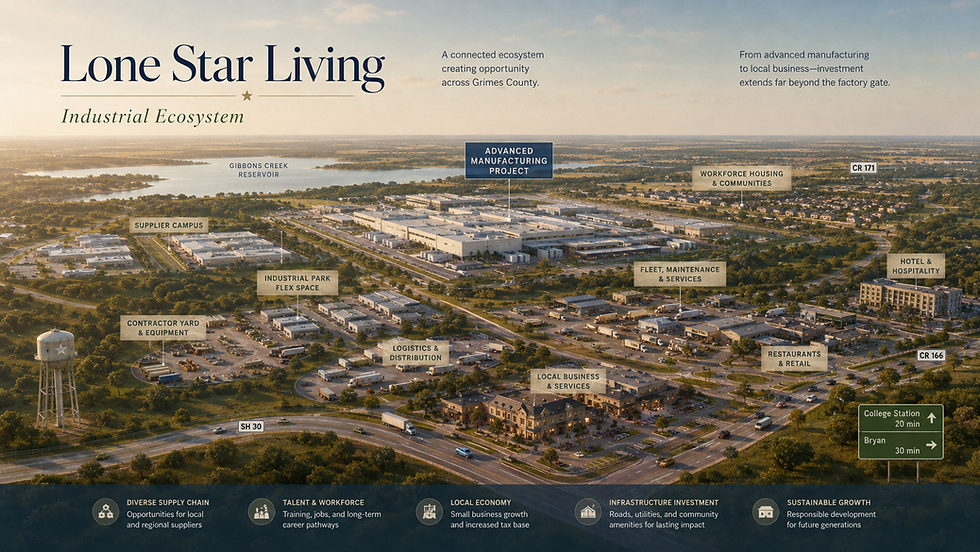
A 3,000-job advanced-manufacturing facility creates housing demand from its direct employees, but its real estate impact can extend much further. Large industrial developments require construction contractors, engineers, maintenance providers, electricians, HVAC companies, logistics providers, security, restaurants, childcare, healthcare, professional services, retailers and numerous other businesses.
Some employees will live close to the facility. Others will commute from established communities such as Navasota, Bryan or College Station. Contractors may need housing for months rather than years. Suppliers may need warehouse, flex or industrial space. Businesses serving the workforce may need commercial sites. Developers may begin positioning residential land well before the permanent workforce is fully established.

Housing Could Be One of the First Markets to React
Terafab’s workforce will not consist of a single type of employee. Advanced manufacturing requires engineers and highly skilled technical workers, but the broader ecosystem also generates middle-income workforce demand. That creates a potentially interesting opportunity for attainable and middle-market housing.
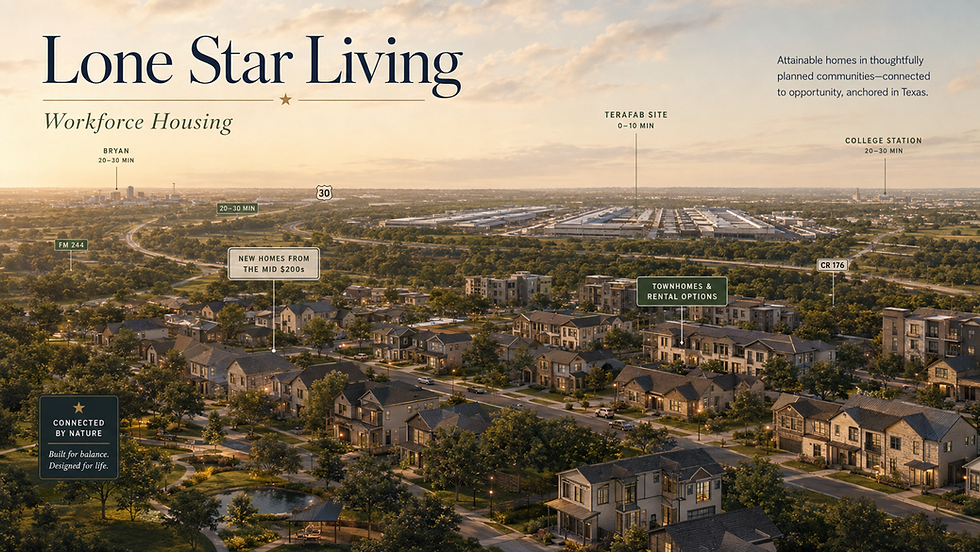
Navasota has an established city structure and access to services. Anderson and portions of central Grimes County could attract buyers or renters seeking proximity with a more rural environment. Bryan–College Station offers significantly more established housing, healthcare, retail, restaurants and employment infrastructure, making it a logical spillover market even though it is farther from the facility.

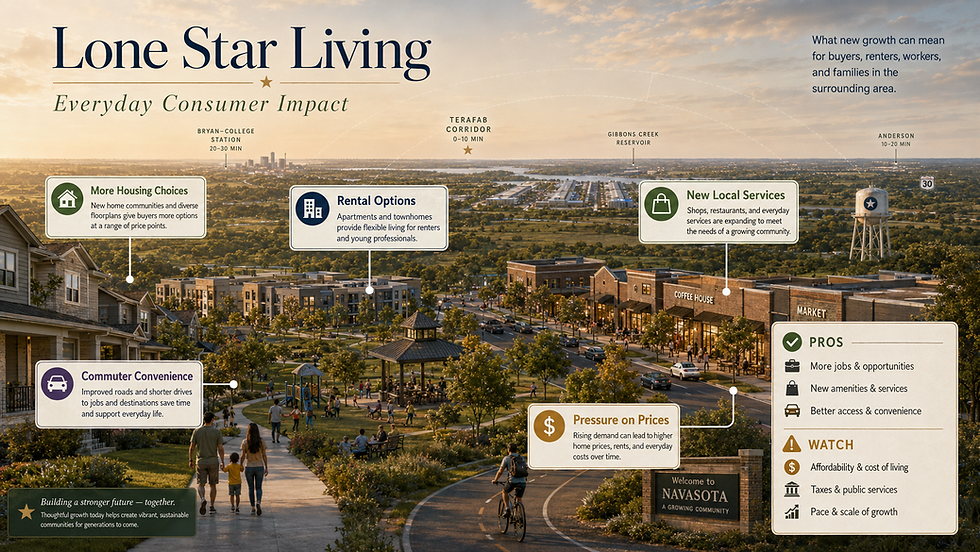
For Investors, Infrastructure May Matter More Than Distance
One of the biggest mistakes investors can make after a major project announcement is buying property based solely on mileage from the project. A parcel five miles from Terafab is not automatically better than a parcel fifteen miles away. Access matters. Utilities matter. Drainage matters. Road capacity matters. Development restrictions matter.

The county road network is especially important because project-related improvements can change accessibility and development feasibility. The roads, utilities and development nodes that emerge around Terafab may ultimately matter more to land value than a simple radius around the plant.

MUDs, PIDs, Bonds and Development Financing
The current Terafab structure is not itself a traditional MUD, PID or TIRZ-financed development model. But those mechanisms may become increasingly relevant as residential and commercial developers acquire land around the growth corridor. New subdivisions can require water, wastewater, drainage, roads, detention, parks and other infrastructure. Depending on the project, those costs may eventually be financed through MUD taxes, PID assessments, bonds, developer reimbursement agreements or other public-private tools.
For buyers and investors, that means the headline home price is only part of the analysis. Total tax rate, district debt, assessments and infrastructure obligations can materially change carrying costs and long-term returns.
Land Is Where Investors Need to Be Especially Careful
Major corporate announcements can cause landowners to reprice acreage almost overnight. A property that was marketed based on agricultural use yesterday may suddenly be marketed as “near SpaceX.” That phrase alone does not create development value.
Before paying an industrial-growth premium for land, an investor should know whether the tract has practical road access, adequate utilities, usable topography, manageable drainage, realistic wastewater options and an economically feasible path to development. A tract sitting along the future direction of growth may be extremely valuable. A tract surrounded by infrastructure limitations may remain difficult to develop even if Terafab is visible from the property.


Commercial and Industrial Opportunity Extends Beyond the Factory Gates
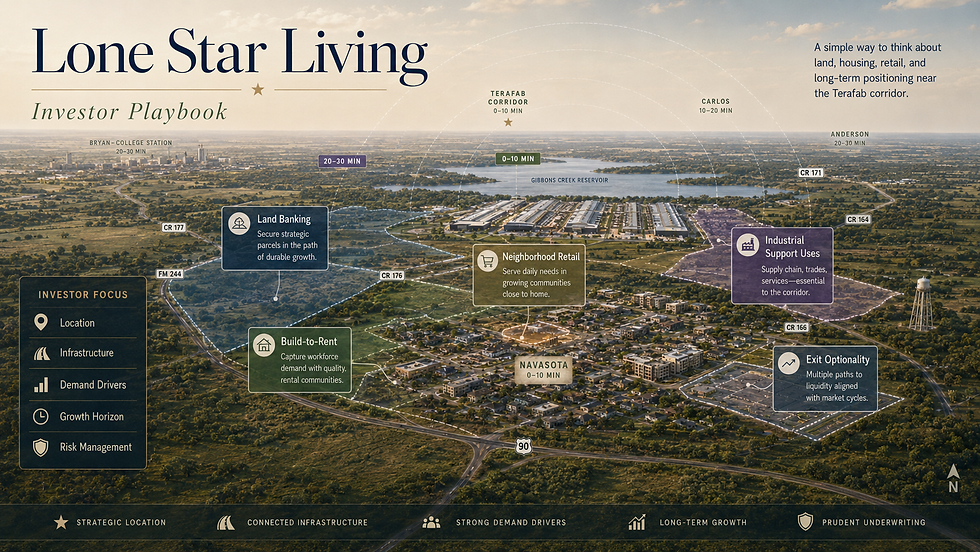
The investment opportunity is not limited to homes and raw land. Thousands of workers and a growing supplier network can support neighborhood retail, restaurants, childcare, healthcare, small offices, hotels, contractor yards, maintenance businesses, flex industrial space, logistics services and other support uses.

Build-to-Rent and Rental Demand
One sector worth watching is build-to-rent. A professionally managed single-family rental community can appeal to employees who want more space than an apartment but are not yet ready to purchase. The thesis becomes stronger where the community has good road access, established services, quality amenities and a reasonable commute to both Terafab and the broader Bryan–College Station employment base.

Opportunity Zones Add Another Layer
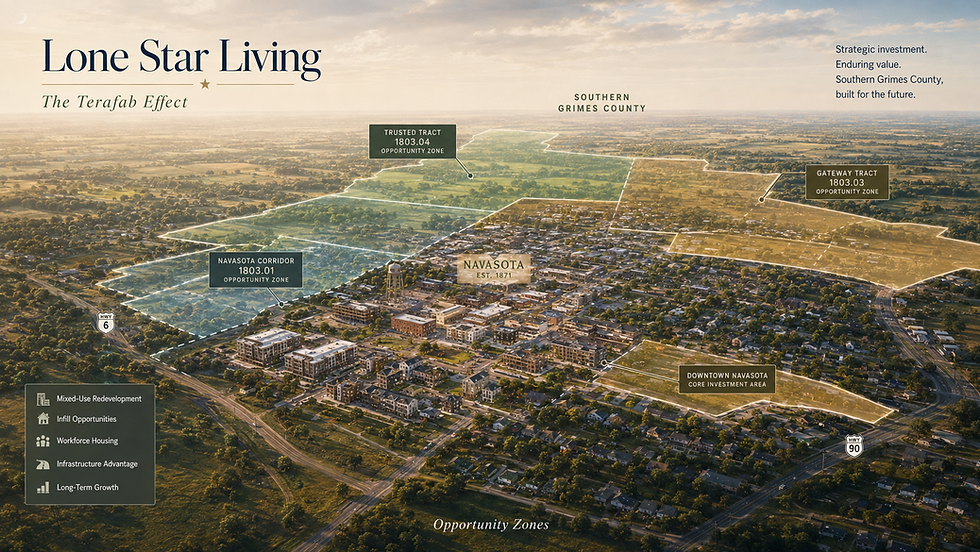
Grimes County contains federally designated Qualified Opportunity Zone census tracts, and Texas is also moving through the next Opportunity Zone designation cycle. That creates a potentially valuable overlap for investors who can identify property that combines sound real estate fundamentals with qualifying tax-advantaged geography.
But an Opportunity Zone should be treated as a tax structure layered onto a good investment—not as a reason to purchase a bad property. Tax advantages cannot fix poor location, weak demand, bad underwriting or nonexistent infrastructure.

Where I Would Be Looking
Middle-market rentals that work financially under today’s rent assumptions.
Developable land positioned along strong transportation and utility corridors.
Small industrial or flex properties capable of serving contractors and suppliers.
Commercial sites positioned to capture workforce population growth.
Properties inside confirmed Opportunity Zones where the underlying investment already makes sense without the tax incentive.
What Investors Should Watch Next
Over the next several years, some of the most important real-estate signals may have very little to do with SpaceX press releases. Watch subdivision plats. Watch utility expansions. Watch county-road projects. Watch TxDOT planning. Watch land assemblies. Watch commercial permits. Watch new apartment and build-to-rent proposals. Watch MUD and PID creation. Watch water and wastewater service areas. Watch where builders begin acquiring acreage. And watch where employees actually choose to live.
The Bigger Investment Story
Terafab could become one of the most consequential economic-development projects in this part of Texas. But sophisticated real estate investors do not chase headlines. They follow jobs, infrastructure, population, utilities, capital and development patterns.
The opportunity surrounding Terafab may ultimately extend well beyond the factory gates—from Grimes County into Navasota and toward the Bryan–College Station market. Some of the strongest investments may not be the properties closest to SpaceX. They may be the properties positioned where Texas’ next growth corridor is forming before everyone else can see it.
Primary sources reviewed for this analysis include the Office of the Texas Governor’s Terafab announcement, Grimes County’s executed SpaceX tax-abatement and economic-development agreements, Texas Comptroller JETI materials, the U.S. Census Bureau, IRS Opportunity Zone designation materials, and the Texas Governor’s Opportunity Zone program resources. Investors should verify exact parcel boundaries, tax districts, utility service, floodplain, zoning or ETJ status, Opportunity Zone status and development feasibility before acquiring property.
This article is for educational and informational purposes only and is not legal, tax, financial or investment advice. Opportunity Zone treatment and other tax incentives should be reviewed with qualified tax and legal professionals.
This article is provided for general informational, educational, and marketing purposes only and should not be considered legal, tax, financial, lending, appraisal, inspection, insurance, or other professional advice. Readers should consult the appropriate licensed or qualified professional regarding their individual circumstances.
Adriana Perez is a Texas REALTOR® and licensed Texas real estate sales agent affiliated with The Trochilidae Group and sponsored by Surge Realty. Licensed in the State of Texas.
Real estate markets and property information can change without notice. Information regarding property availability, pricing, incentives, interest rates, taxes, assessments, schools, zoning, flood information, development plans, market statistics, square footage, property characteristics, and other real estate information may be obtained from sources including HAR/HRIS MLS, public records, builders, developers, lenders, governmental agencies, and other third-party sources. Information is believed to be reliable when published but is not guaranteed and should be independently verified before making a real estate, financial, or investment decision.
Properties, developments, builders, lenders, vendors, communities, or other businesses discussed in this article are not necessarily affiliated with or endorsed by Adriana Perez, The Trochilidae Group, or Surge Realty unless expressly stated. Properties referenced may be listed or represented by another real estate broker. Nothing in this article should be interpreted as a representation that Adriana Perez or Surge Realty is the listing broker for a property unless expressly identified as such.
Any builder incentives, lender programs, financing examples, interest rates, grants, down-payment assistance programs, seller concessions, promotional offers, or other financial incentives discussed are subject to eligibility requirements, availability, change, or withdrawal without notice. Financing information is provided for general informational purposes only. Consumers should verify current terms directly with the applicable lender, builder, program administrator, or other provider.
Reading this article, visiting this website, or submitting a general inquiry does not by itself establish a brokerage or representation relationship. Any representation relationship is subject to applicable Texas law and required agreements and disclosures.
© The Trochilidae Group. All rights reserved.


Comments